
AI in Hospitality: 6 Uses That Actually Move the Numbers
Almost every hospitality operator has now been pitched an AI product. Far fewer have seen one change a P&L.
The gap usually is not the technology. It is that AI gets bought as a product when it should be deployed against a specific, measurable bottleneck. That could be a phone that rings unanswered after 6 p.m., a schedule that takes a manager four hours every week, or a food cost that drifts three points and nobody notices until month-end.
Here are six applications we see delivering real returns for hotels, restaurants, tour operators and destination management companies, and how to sequence them.
1. Answering Enquiries the Moment They Arrive
Speed of response is the single most reliable predictor of conversion in hospitality, and it is where most independent operators quietly lose business. An enquiry that arrives at 9 p.m. on a Saturday and gets answered on Monday morning has usually already been booked elsewhere.
An AI assistant on the website, WhatsApp or Instagram DMs can answer availability, rates, policy and location questions instantly, qualify the enquiry, and hand a warm, structured lead to a human when the conversation needs judgement.
Where the value shows up: Higher enquiry-to-booking conversion, fewer lost after-hours leads, and less front-desk time absorbed by repetitive questions.
The guardrail: The assistant must know when to stop. Pricing exceptions, complaints, and group negotiations go to a person, always.
2. Reputation and Review Management
Reviews influence booking decisions more than any advertisement you will run. Most properties still manage them reactively.
AI is genuinely useful here in two ways. It can monitor and summarise reviews across platforms, surfacing patterns a manager reading them one at a time will miss. For instance, check-in complaints may cluster on Thursdays, or one room type may generate a disproportionate share of negatives. It can also draft response copy in your brand voice, cutting response time from days to minutes.
Where the value shows up: Faster response rates (a ranking factor on several platforms), and operational problems caught while they are still small.
The guardrail: A human approves every public response, always. An auto-published reply to a serious complaint is a reputational risk, not a time-saving measure.
3. Demand Forecasting and Smarter Pricing
Forecasting is where AI has the longest track record in hospitality, and it remains underused outside the major chains. Models that combine your booking pace, historical patterns, local event calendars, competitor rates, and seasonality can flag demand shifts well before a manual review would.
For a boutique property or a tour operator, this does not require an enterprise revenue management system. Even a well-structured weekly forecast that highlights soft dates early gives you time to act. That could mean a targeted offer, a package, or a reallocation of the ad spend.
Where the value shows up: Improved RevPAR and fewer last-minute discounts made in a panic.
4. Back-Office Automation
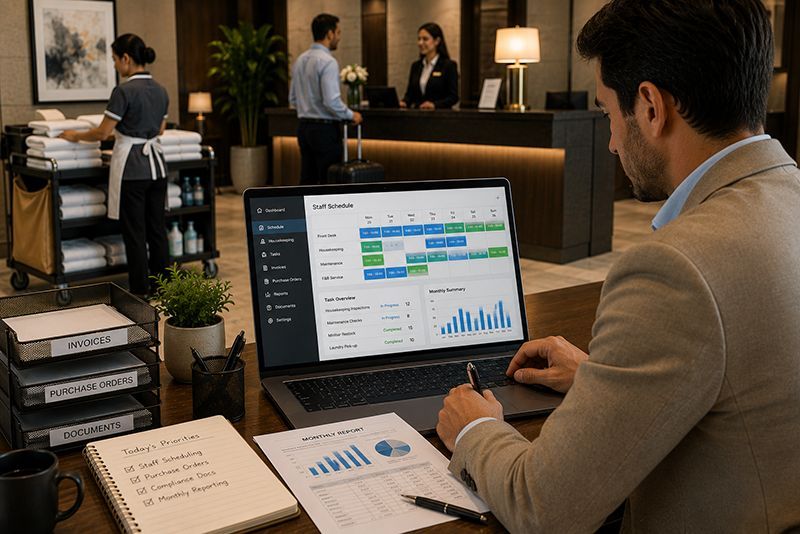
The least glamorous category, and often the fastest payback. This includes staff scheduling based on forecast demand rather than last week’s copy-paste, invoice and purchase-order processing, housekeeping assignments, compliance documentation, and monthly reporting that is assembled automatically rather than rebuilt by hand.
These tasks consume manager hours that should be spent on the floor with guests and staff. Reclaiming eight to ten hours a week of management time is a clear operational gain, and it is usually the easiest win to measure.
5. Marketing Content at Operational Speed
Independent operators rarely have a content team. AI closes that gap by helping with property descriptions, seasonal campaigns, email sequences, social captions, itinerary write-ups, and multilingual versions for international markets.
The guardrail that matters: Generic AI copy is instantly recognisable and actively harmful to a premium positioning. The output needs a defined voice, real property specifics, and human editing before it goes live. Used properly, it can help a marketer produce more without sacrificing quality. Without the right oversight, it can make a luxury brand sound like everyone else.
6. Food Cost, Inventory and Waste
For any operation with a kitchen, this is where margin hides. AI-assisted inventory and forecasting can flag variances between theoretical and actual food costs, predict par levels based on expected covers, and identify waste patterns by station or menu item.
Where the value shows up: Recovering food cost percentage points. On a thin-margin operation, that can often fund the entire technology programme.
A Realistic 90-Day Rollout
Operators who succeed with AI start narrow. Those who struggle try to transform everything at once.
- Days 1-30 – Choose one bottleneck: Pick the problem with the clearest cost. Document how it works today. Establish a baseline number. This could be the current response time, current food cost variance, or current hours spent on scheduling. Without a baseline, you cannot prove a return.
- Days 31-60 – Pilot in one area: One property, one outlet, one channel. Keep the human in the loop. Expect to spend more time on process and prompt refinement than on the software itself.
- Days 61-90 – Measure, then decide: Compare against the baseline honestly. If the numbers moved, expand to the next bottleneck. If they did not, find out whether the problem was the tool, the process, or the training, and fix that before adding anything new.
The Four Mistakes We See Most
- Buying the tool before defining the problem – Technology purchased on enthusiasm rarely gets adopted.
- Removing humans from the wrong moments – Guests tolerate automation for logistics. They do not tolerate it during complaints, celebrations, or anything that went wrong.
- Skipping staff training – An unadopted system is a subscription, not an asset.
- Ignoring data privacy – Guest data carries real obligations. Confirm where it is stored and how it is processed before it leaves your systems.
Where to Start
At Chicot’s Consulting & Hospitality Services, our consulting division helps operators identify which of these applications fits their business and, just as importantly, which ones do not yet. We combine hospitality operating experience with AI-enabled systems, automation, and digital marketing, so the recommendation is grounded in how the business actually runs.
If you are weighing where AI fits in your operation, explore our AI-enabled solutions or
book a consultation. We will start with the bottleneck, not the software.